Personal notes from the three-day workshop Agentic AI for Earth Observation, organized by ESA Phi-lab and BIFOLD, with NASA, Ethereum Foundation, and Mistral among the participants.
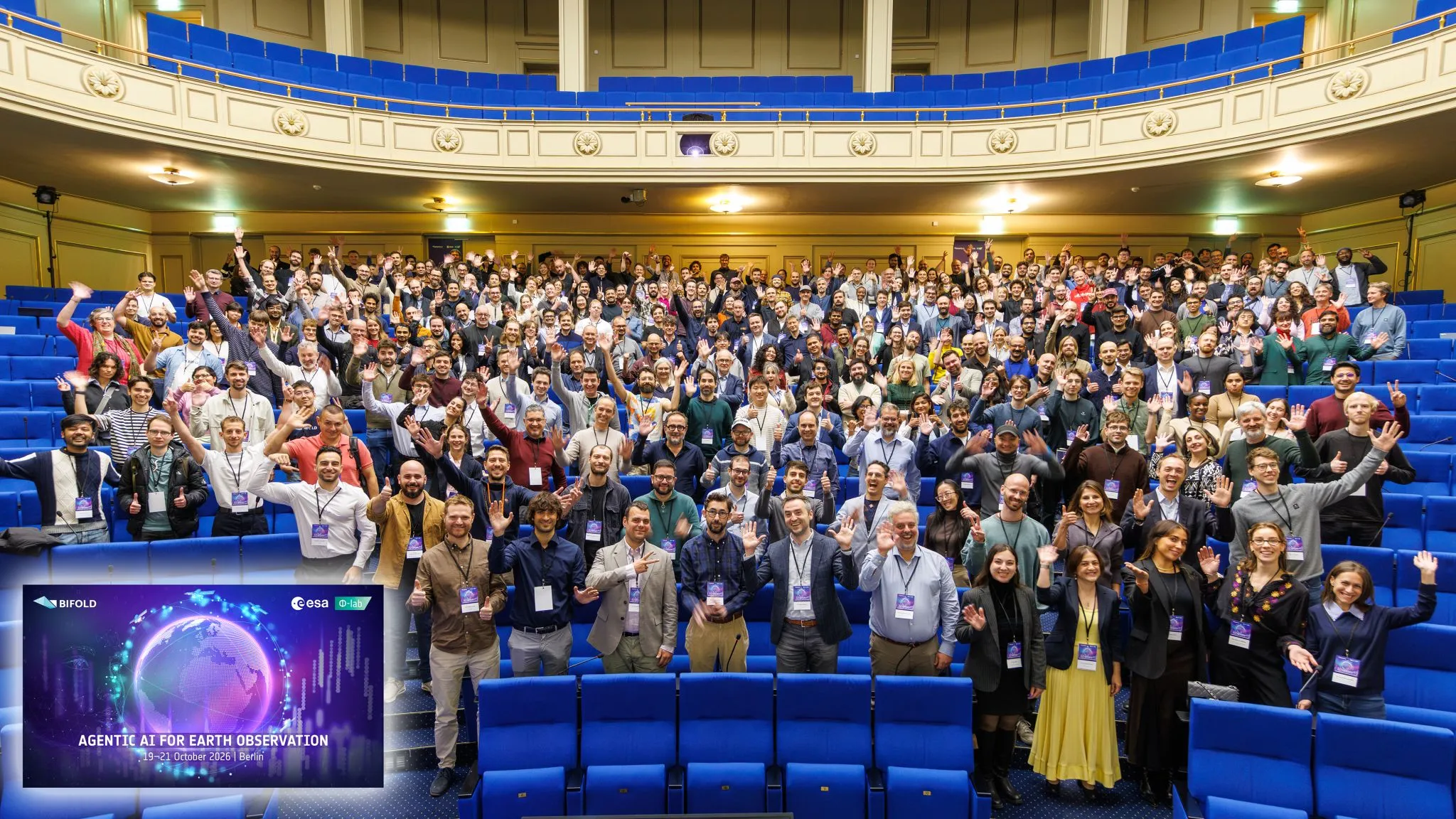
The main themes were:
- Trustworthiness: how agentic systems can support decisions in Earth observation (EO) while remaining reliable and transparent.
- Foundation and fine-tuned models: how do foundation models and fine-tuned smaller models compare across different tasks?
- Integration: how agentic systems will be integrated into production environments, with a focus on edge deployments.
The main takeaways were:
- Multi-agent workflows perform better than single-agent ones.
- Many different benchmarks exist, with no agreement on which to use.
- Agents are needed when the answer requires a long workflow over heterogeneous data, not a single prediction.
- Small, specialized models, explicit plans and references instead of raw rasters make agents cheaper and more reliable.
- Trustworthiness and the boundary between autonomy and human responsibility remain open problems.
- The American point of view, compared to the European one, is that they want to remove the human from the loop.
Personal Considerations
- The human in the loop is the bottleneck. The only thing we can do is create proper boundaries with tools so that humans can trust these phases.
- Many people seem to be building everything from scratch, and there is no real reuse of EO tools. Where is the reuse?
- How can we do hallucination detection? Is it possible to use anomaly detection for it?
- There was little focus on the uncertainty of model predictions, which is fundamental for critical decisions. Only a few projects mentioned uncertainty.
First Day
1. Motivation: Why Agentic AI for EO?
Claudio Iacopino (Head of Explore Office, ESA Phi-lab)
Earth observation is the leading activity of the agency, and FutureEO is the ESA R&D programme dedicated to it. It is organized in three elements:
- EO Foundations
- EO Missions and Data
- Earth Action: aims to produce concrete actions based on climate and environmental data.
Phi-lab is an open lab that carries out research to let a technology mature, and then invests in it. Its Explore Office covers:
- Foundation models, digital assistants and twins, generative and agentic AI.
- Cognitive space with on-board AI, quantum computing, neuromorphic computing and biocomputing.
- Virtual and immersive visualization, distributed ledgers and blockchain.
Producing EO data alone is no longer enough.
Data must be combined to be understood, and decisions must be taken under uncertainty. The main applications are disaster and fire management, urban extreme heat, ship identification and tracking, and national-level intelligence models.
Two initiatives were presented:
- World Agentic Engine: an agentic-AI-driven capability able to orchestrate models on top of a shared semantic layer. The goal is to align all players in the EO industry to foster an efficient use of European EO assets. The concept is integration and reduced duplication.
- EOCognitiveLab: focused on AI and a space data center to create an in-orbit laboratory. With two core satellites, the goal is to demonstrate autonomous constellation orchestration, cooperative sensing and event-driven acquisition replanning.
Four questions guided the workshop:
- When is agentic AI needed, because classic EO workflows are not enough?
- How can agentic systems remain trustworthy?
- How do we move from demonstrations to an interoperable ecosystem?
- Where should autonomy stop and human responsibility begin?
2. Agentic AI for EO and Climate Resilience
Salman Khan (Professor, Mohamed bin Zayed University of Artificial Intelligence, MBZUAI)
A flood map does not give an actionable answer. Decision makers need to know which schools and hospitals are in the flooded area, which roads still reach them, and where help should go first.
Answering complex, decision-related questions requires a workflow, not a simple forecast.
The proposed progression is:
flowchart LR
    A["Vision Foundation Models"] -->|adapt to satellite imagery + language| B["Remote Sensing VLMs"]
    B -->|add planning + tool calls| C["Tool-Using EO Agents"]
EO agents are challenging for three reasons:
- Workflows are long: many data sources and models must be combined over a long horizon.
- Data are heterogeneous.
- Context explosion: GeoTIFF and GeoJSON files are far larger than the model context.
Three works were presented.
OpenEarthAgent
- Code: mbzuai-oryx/OpenEarthAgent
- Paper: arXiv:2602.17665
The question is whether a 4B model can use geospatial tools. The authors started from Qwen3-4B, which was not able to order the tool calls correctly, and fine-tuned it on structured tool-use trajectories. The model follows a Reasoning & Action (ReAct) loop.
Tool-selection accuracy is the key metric, because it shows whether the model has learned to use the available tools correctly.
The demos included:
- Shortest distances from all kindergartens in an area to the closest police station.
- Estimating the heading of the largest aircraft in an image.
- Counting the buildings that remain in a before/after damage image.
They also studied a workflow with two agents, a planner and an executor that calls the planned tools. Multi-agent workflows achieved better results.
GeoFaham
- Code: microsoft/GeoFaham
“Faham” is an Arabic-origin word meaning understanding. The system has an orchestrator and four specialist agents: vector, map, STAC and raster. The demo identifies the schools close to a flood. It is evaluated on GeoFaham-Bench, with 40 tasks from 17 real disasters. The system is built on OpenAI models, and each task is assigned to a suitable model to optimize cost. They noted that GPT-4o performs very well as the STAC and raster agent.
TerraBench
- Paper: arXiv:2606.13148
The question is whether agents can reason over heterogeneous Earth system data (reanalysis, forecasts and so on). An example task is: how much rain fell over agricultural land with NDVI > 0.2?
In the rainfall example, Sonnet’s answer was higher than the reference.
Lessons Learned
- Small specialized models can compete with bigger generic models.
- Make the plan explicit.
- Pass references instead of raw rasters.
- Score the answer, not only the recipe (the workflow).
3. Agentic Decision Intelligence and Earth Action
A Decision-Driven, Hazard-Agnostic AI Framework for Earth Observation: Demonstration Through a Flood Response Use Case
Firoozeh Foroozan and Carlos Pino Padilla (Indra Space)
The goal is to transform the volume of EO data into timely decisions. The flood segmentation model, DeepLabV3+, is the foundation of the system. The agents are orchestrated with LangGraph, and the workers have no edges between them: they communicate only through the orchestrator.
Multi-Agent Early Extreme Events Detection from IoT to Earth Observation Tasking
Arnauld Le Carvennec and Axel Gruyez (CS Group)
Transformer- and agent-based extreme event detection. Extreme events are becoming more frequent and dangerous, which motivates automatic detection.
Wildfire Lifecycle Monitoring from Earth Observation
Rishi Madhok and Fuxun Yu (TerraByte AI)
The lifecycle is:
flowchart LR
    A[Detection] --> B[Monitoring] --> C[Assessment] --> D[Recovery]
The FireTrack model is based on VIIRS and uses either a CNN or the frozen Prithvi-EO-1.0-300M encoder, with skip connections to a U-Net decoder.
- Related code (VIIRS fire tracking, NASA EIS): Earth-Information-System/fireatlas.
Agentic Orchestration of EO Foundation Models via Model Context Protocol
Pinaki Banerjee and Rocco Sedona (Jülich Supercomputing Centre)
The goal is to make AI tools available to people who are not familiar with EO. The work used TerraMind v1 large.
- Model: IBM/terramind
- Fine-tuning toolkit: IBM/terratorch
TerraScope: Pixel-Grounded Visual Reasoning for EO
Yan Shy (University of Trento)
An interesting talk about a model that handles both segmentation and analysis in one system, interleaving pixel-level masks with textual reasoning.
- Paper: arXiv:2603.19039
4. Earth Observation in the Age of Agentic AI: From Insight to Business
Julia Gottfriedsen (CTO, Constellr), Marcin Detyniecki (AXA), Andres Camero (DLR) and Linda Sheard (Xoople)
5. Subway Takes: Agentic AI Edition
Eva Gmelich Meijling and Riccardo D’Ercole (ESA Phi-lab)
Each participant proposed a take on agentic AI, and after a vote the open discussion started. Three points were discussed:
- Is agentic AI making scientific research less scientific? What happens when non-expert people use models without knowing the theory behind the application?
- Should the validation of scientific publications via agentic AI be a goal?
- How many foundation models do we need? Is one enough, or do we need many? Would a good coordinator with many specific models be better?
Second Day
The Rise of Agentic AI
Jacopo Chevallard (AI Development Strategist, Mistral AI)
The talk focused on the product they developed with an open-weights model.
Topics:
- Ecosystem dynamics
- Four levers for builders of EO agents
- Implications
General AI agents still get only a third of EO questions right, despite the huge number of scientific contributions on agentic EO.
The skeleton is always the same: an LLM and tools.
The central planner is the most important element because it is the shared critical component.
Who builds the intelligence layer? This is important for Europe, which needs control in the AI revolution and therefore needs to own the intelligence layer.
Mistral started investing in compute capacity, specifically sovereign compute capacity, and is working with TotalEnergies on geoscience models. Companies have understood that they cannot rely on external API calls or external intelligence layers.
Part 1
The OSWorld benchmark gives an indication of the capabilities of foundation models and agentic AI in a multimodal setting, but it does not generalize to specific fields like EO.
Open models trail the closed frontier models by about four months. Most of them come from China (8 of the top open models are Chinese), but Europe is back in the race.
The cost of intelligence is falling by 13x per year.
Open interfaces like Model Context Protocol (MCP) and Agent2Agent (A2A) have become standards under the Linux Foundation, no longer controlled by private parties. We can therefore build EO tools once as MCP servers and reuse them anywhere.
The first layer of a sovereign AI is made of four kinds of sovereignty:
- Data sovereignty: keep critical knowledge and secrets. Intellectual data should stay in our system, and the model should come to the system.
- Intelligence sovereignty: with the model in the system, we can fine-tune it on internal trajectories and compound this intelligence over time.
- Compute sovereignty: you should choose where to run AI models. We need regional inference.
- Operations sovereignty: control the entire end-to-end agentic stack.
Part 2
The four levers are:
- Reliability
- Vision
- Specialization
- Training
Reliability is the major limitation, because agents fail, especially in EO. It should come from what surrounds the model, namely tool calls.
We should have a verification layer at every step (raster, physics, metadata).
Even though reasoning models are becoming very capable, SAR, multispectral and time-series data still need EO foundation models and tools.
Small specialized models beat large general ones on narrow tasks. An example is the EVE project, trained on Mistral Small.
For training, they have recently focused on mid-training and online RL, where the reward comes from a verifier rather than a label.
A small model trained with online RL can beat much bigger models.
Science means reproducibility! We touched on this topic yesterday in the final discussion. For agentic systems we also need to freeze the agent’s world: the traces of the model should be published and the model version pinned.
LLMs are very well suited to training surrogate models from simulations. This is an offline flywheel: create the surrogate model, then use it as a tool that the agent can call. This way we can get an answer in a few seconds.
The model is temporary, because foundation models are released quickly. The real assets are the data, the evaluations and the traces.
Chinese companies dominate the open-weights landscape. The scaling law has been confirmed, and more compute means a better model. Money is also a problem, because Mistral pays for energy in the same way everyone else does, while Chinese companies have government funding.
FAME: Traditional and Agentic AI in Space
Steve Chien (AI Group, NASA JPL)
FAME is an effort to demonstrate coordination across a fleet of autonomous spacecraft: coordinating activities, measurements and insights.
Dynamic Targeting (DT) makes AI decisions in under 60 seconds, so the satellite itself can interpret the data it collects. The project is a collaboration with Ubotica and Open Cosmos. They expect DT to become commonplace across many future Earth science missions.
Another focus is onboard scheduling, so that the spacecraft can manage its own resources.
They are also using large models to generate goal-based behavior in space. For example, a VLM can take an image of a fire, use tools such as wind, air quality and trajectory calculation, and decide whether actions are needed for health and agricultural purposes.
Other examples are zero-shot scene classification, open-vocabulary detection and localization, visual question answering (VQA) and open-ended queries (for example, “how many quadjets are visible in the image?”).
He sees scene classification as the main application of LLMs in orbit, although they have been working on specialized classifiers for decades.
Autonomous EO Systems, Space Operations and Cognitive Computing in Space
Agentic Orchestration of Satellite Tasking and Data Retrieval in Earth Observation Virtual Constellations
There are two kinds of agents in the agentic orchestration layer: an orchestrator and mission agents, which communicate via the A2A protocol.
The flow is:
flowchart LR
    A[User Message] --> B["Agent Discovery by the Orchestrator<br/>(available agents + their skills)"] --> C[Simulation, Optimization & Negotiation]
The negotiation happens among the agents to get the best acquisition for the case at hand.
Autonomous Agentic Command and Control for Satellite Constellations: An AI-Accelerated Engineering Demonstration
Alessio Auddino (Thales Alenia Space)
Managing large fleets is becoming more complex because the number of satellites keeps growing. Connecting the nodes is hard because it is a distributed-system problem.
The AI agent flow is:
flowchart LR
    A[Observe] --> B[Simulate] --> C[Authorize]
They used LangGraph and Kubernetes for the production environment.
Toward Cognitive Cloud Computing in Space: AI-eXpress as an Orbital Testbed for Agentic Earth Observation
Marco Bucci Beltrami (Planetek Italia)
Problems:
- High latency between collection and delivery to the user.
- Missed observations because of clouds.
It is therefore difficult to react quickly to observations.
AI-eXpress is a fleet of satellites composed of three nodes.
There are three steps towards agentic EO:
- Planning: what should we observe?
- Processing: agentic edge processing.
- Collaborative multi-agent operations.
The hardware used was Unibap.
Agentic Mission Computing for Autonomous Earth Observation
Leonidas Kosmidis (Metasat)
How can we enable onboard AI for institutional missions?
The SHERPA project focuses on extreme events and on performing computation on board. This requires far more computing power than current hardware can provide.
He mentioned that Linux is not considered safe, so they used an FPGA. ESA dictates which software and hardware can go into a mission based on its type and cost. Class 1 is the strictest mission class. Linux is so big that it is not possible to prove that it meets all the requirements.
The simpler the software, the easier it is to verify the requirements.
Example usage:
- A U-Net for cloud screening.
- YOLOX-Tiny for object detection.
Closing the Reasoning Latency Gap: FPGA-Accelerated LLM Agents for Onboard Supervision of Earth Observation Acquisition
Winfred Ooh-Azlin (TU Berlin)
A Qwen2.5-1.5B model, quantized to 4 bits, ran on a single Cortex-A72 CPU core without an accelerator.
From Earth Observation to Earth Intelligence: Opportunities, Challenges and Future Directions
Mikhail Klassen (Planet Labs), Bertrand Le Saux (DG CONNECT) and Ioannis Papoutsis (National Technical University of Athens)
What does Earth intelligence mean?
The stack is:
- Data stack
- Models and compute layer
- Agent and query layer
In the future there will be digital twins and Earth models. We are moving from only observing to deciding what to do.
Technical problems in agentic systems, and where to focus:
- We don’t have time-series foundation models.
- Physical consistency is missing in LLMs.
- There is no agreement on which benchmarks to use, and on the existing benchmarks agentic systems perform very poorly.
How should we trust the output of agents? How much autonomy should we allow?
We should add autonomy, observe the failure modes and fix them. Step by step, all autonomous systems will follow the same path as autonomous cars.
Earth intelligence is growing very fast. What will it look like in 5 to 10 years? Something very multimodal and very low resolution.
Design, Development and Evaluation of AI Agents
Collaborative Agent Reasoning Engineering (CARE): A Structured Context Engineering Methodology for Systematically Designing Traceable and Maintainable AI Agents for Science
Rohit Sisir Sahoo (University of Alabama)
Evaluating an EO-Specialized LLM in Agentic Frameworks
Riccardo D’Ercole (ESA Phi-lab)
The goal was to put EVE into a proper agentic framework. Are specialized models good at orchestrating specialized tools?
EVE is built on Mistral Small 3.2 24B, and they built a suite of models. EVE was very good at orchestration but not at efficiency.
They designed PhiLiveBench.
Domain specialization does not automatically translate into agentic performance.
EO Agent Arena, an EO-Specialized LLM, in Agentic EO Systems
Najah Pokkiri (Axis Spatial)
Which AI model is best for geospatial work? Geospatial AI has no shared leaderboard.
Behavioural Self-Monitoring for Autonomous EO Agents: The Attribute Reliability Monitor (ARM)
Alejandro Mousist (Thales Alenia Space)
They recently started working on thermal infrared, which is not a very common modality. The CTO of Constellr also mentioned it.
They created their own VLM and used the SPARK dataset.
Agents should monitor their tools, because there is no ground truth in space.
Balancing Accessibility and Scientific Validity in the Era of AI Agents and Climate Change
Elena Di Medio (Lobelia Earth)
How can AI tools simplify accessibility?
From Tools to Ecosystem: EVE’s Community-Driven MCP Registry for an Agentic Platform for Earth Intelligence
Alex R. Atrio (Pi School)
An explanation of the EVE platform. EO resources are fragmented, and access to them is manual.
- EVE-Instruct was the goal of phase 1. It has RAG for scientific data.
- Phase 2 is the planning and tool-invocation layer over the catalogue.
- The open part is for now limited to retrieval.
- There are 28 tools so far, covering wildfire, disaster, geocoding and more.
- It follows open standards.
- The tool registry is curated and limited to EO services.
- All tool calls are auditable with the trace.
- The EVE platform is model-agnostic. The default model is EVE-Instruct, but the two are distinct.
The orchestrator agent has:
- Core tools
- Tool search
- Skill index
- Spawn agent: agents can be shut down.
Building with Mistral Open Agentic AI Tools: From Scientific Discovery to Operational Services
There is no specific answer to when to use a small model and when to use a big one.
Image loop:
flowchart LR
    A[Load Scene] --> B[Zoom & Crop] --> C[Locate] --> D[Measure] --> E[Compare Dates] --> F[Answer with Evidence]
    F -.->|Iterate| A
A typical task takes 6 to 10 tool calls.
Pipeline:
flowchart LR
    A[Mistral Large 4] --> B[Tool Calls / Foundation Models] --> C[Metadata & Raster Checks] --> D[Physical Verifier]
Pixtral-12B + LoA.
Timestral is a time-series foundation model that has just become competitive with boosting techniques for time series. It is very small, has the best performance, and is open-weights. It works zero-shot, compared with XGBoost.
Physics surrogate:
flowchart LR
    A[Simulations as Input] --> B[Train the Surrogate] --> C[Validate] --> D[Serve as a Tool]
Part 2
Forge is for model customization, and Studio allows building workflows.
Mistral’s goal is to embed the AI product in your system.
Mistral Vibe is like Claude Code but allows self-hosted models.
With Forge you can fine-tune your own model.
How EVE was trained:
- Curate an EO corpus.
- Generate synthetic data (a phase of paramount importance for all models).
- Fine-tune Mistral Small.
- Evaluate on an EO benchmark.
- Add retrieval and checks.
- Serve with MCP tools.
Third Day
Building Robust Economic Capabilities in AI Agents
Davide Crapis (Ethereum Foundation)
ESA Phi-lab collaborates with the Ethereum Foundation to investigate possible applications of markets for EO data in space.
Why Mature Agents Require a Paradigm Shift in Tooling
Christopher Forrest Brown (Google DeepMind)
EO problems are not formally verifiable and are not quick to evaluate, so they are hard for agents to solve. Solutions are not programs that can be executed. Agents can mainly act as orchestrators of GIS tools.
Custom harnesses depreciate over time, because general tool chaining improves as models scale.
Research SOTA differs from operational SOTA.
Embedding products face a trilemma:
block-beta
    columns 3
    space G(("Generality")) space
    space:3
    P(("Performance")) space C(("Compactness"))
    G --- P
    G --- C
    P --- C
The information that goes into the embedding has to be chosen before the embedding is created, so it does not generalize. Embeddings don’t solve everything.
Startups begin by building products around applications that were not possible a year earlier, but models do not transfer.
He is a foundation-model skeptic. A lot of focus goes to the task, which is something state-of-the-art models do not consider.
The best tools we can provide to agents won’t be EO models, but structured knowledge.
It is faster to review code than to write it (the classic P vs NP problem). Focus on EO data, workflow traces and domain expertise, and use agents to build the next generation of tools.
AlphaEarth started as a project on embedding fields. The goal was to create a synthetic satellite that can answer questions at any resolution, for any place, at any time.
Self-supervision helps make our discontinuous data continuous (swaths and differences in time), as the world actually is.
He recommended focusing on:
- Using all the available data, such as a small dataset of worms with only six samples.
- Integrating new satellites with sensors that have no history.
Multimodal Large Language Models, Datasets and Agentic Earth Intelligence
APERTURE: Semantic Change Understanding and Grounded GeoAI Reasoning via SAR-Optical Language Alignment
Magdalena Kaiser (LiveEO)
They tried optical and SAR data but did not get good results, because the model did not use SAR during fine-tuning. The VLM was only able to detect disappearing objects.
They created a new dataset, GeoCap, with optical and SAR data, and want to build a SAR-optical aligned vision encoder to see whether SAR adds value.
BigEarthNet.txt: A Large-Scale Multi-Sensor Image-Text Dataset and Benchmark for Earth Observation
Mathis Jürgen Adler (TU Berlin)
Data is the problem.
Toward Agentic and Unified Agricultural Field Boundary Delineation from Satellite Imagery Using Geospatial Foundational Models, Pre-Trained Segmentation and Embeddings
Sayantan Majumdar (DRI)
Evaluation of Agentic Autoresearch on an Earth Observation Benchmark
Alex Lopez-Cifuentes (Xoople)
This work builds on Karpathy’s autoresearch and extends the idea to Earth observation.
How capable are current frontier LLMs, in an agentic setup, at training better EO models? They used the PANGAEA benchmark with two setups:
- A fixed U-Net.
- A free architecture search.
A data agent set up the PANGAEA benchmark, from downloading the data to verifying the baseline. A model agent handled hypothesis drafting, model training and validation. The best configuration is then retrained with the full protocol.
Watch out for metric gaming by the models during training.
GeoFMOps: An Agentic Framework for the Geospatial Foundation Model Lifecycle in Earth Observation
Fabrizio Rosmarino (University of Bari and Planetek Italia)
Using a GeoFM within an agentic framework.
How can the foundation-model lifecycle be automated (model selection, onboard deployment) without losing quality and control?
See also AI-eXpress.